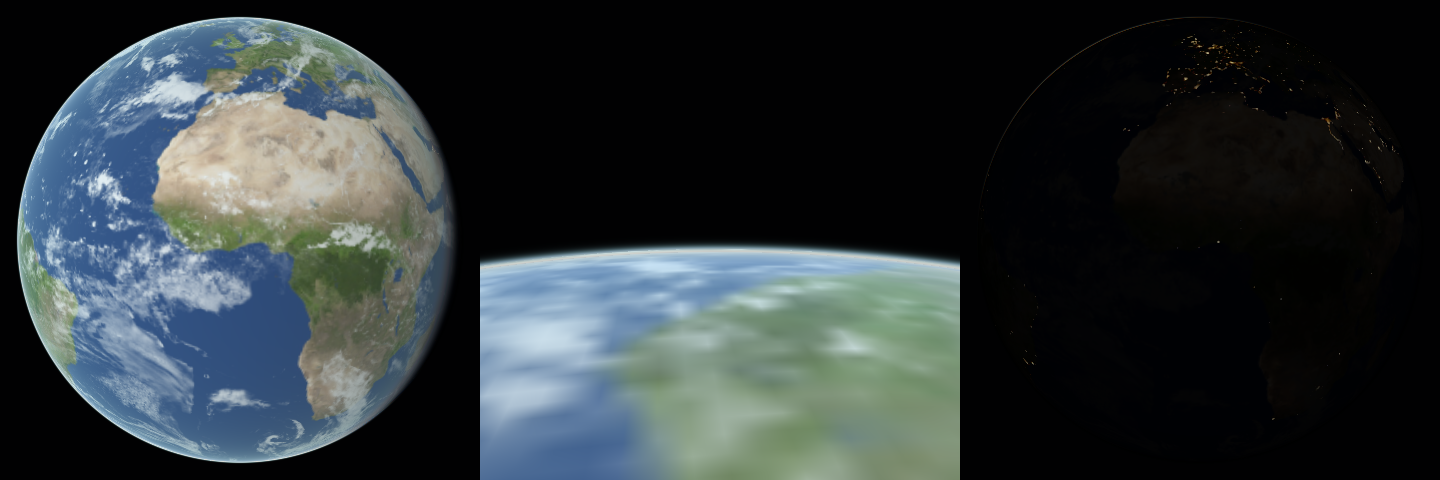
Follow the planets and moons, compare physical distances and view the same instant from different perspectives. Use the orbital view to see the system, then turn a question about Earth and Mars into a distance investigation.
Models and tools
This blueprint brings together one approximate Keplerian orbital model with complementary tools: synchronized WebGL views, physical distance charts, closest-approach search and portable saved investigations. These tools use the same physical model; they are not independent scientific solvers.
Orbital exploration
Sun, eight planets and twelve moons
Data interval
1 January 1990 – 1 January 2031 UTC
Visualization
Up to six synchronized views; independent cameras and display settings
Analysis
Physical distance charts and next closest approach for planets
Investigation state
Version-1 JSON import/export and browser autosave
Open the model · hosted agent access in setup
Open model launches Solar System in your browser. Explore it without login or an agent. Hosted ChatGPT access is in setup and is not available yet.
The intended private pilot connects ChatGPT to a tab you explicitly approve. The calculation and visualization stay in the browser. A new user will not need a terminal, Node.js, a local server, a tunnel, an extension or API credentials.
Keep the tab open and responsive. Background and mobile tabs can be suspended. Select each session explicitly in ChatGPT; a session label or ID is not authorization. Disconnecting stops further commands but cannot undo completed changes.
Open Solar System and explore the model manually.
When the pilot is available, open Agent access, sign in and explicitly enable read access or control for this tab.
Connect the VizualModel OAuth integration in ChatGPT once, using the same identity.
List sessions in your conversation, choose this tab and inspect its state before making a change.
The existing application operation selects the bodies, searches the chosen range and pauses at the result. Agent access will use the same calculation. Display enlargement does not change physical separation.
INVESTIGATION 01
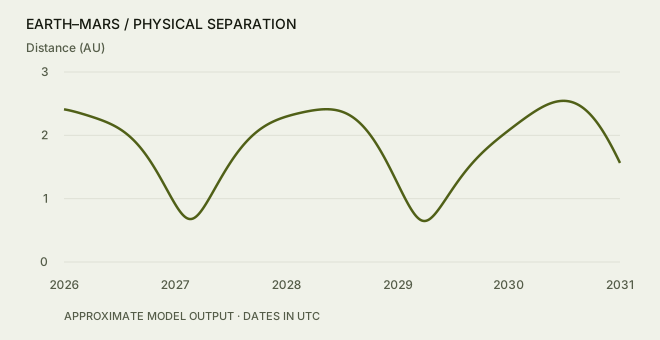
When are Earth and Mars closest?
In the browser, open Distance charts and select Earth and Mars. Choose Next closest approach. The application pauses at the next model-derived local minimum before the selected end date. Compare successive events or export the session to revisit one.
Positions use downloaded osculating elements, Kepler propagation and blended Cartesian positions. Planet elements are sampled every eight days; moon elements daily. This is not numerical N-body integration or an exact reproduction of JPL Horizons. It cannot establish long-term gravitational stability.
Geometric positions omit light-time effects. UTC-to-TT conversion uses a fixed TAI–UTC offset across the interval. Axial rotation and satellite trajectories include approximations. Body enlargement and moon spread are presentation settings.
Software tests cover mathematical invariants, dataset coverage, continuity and state behavior. Independent positional-accuracy comparisons against reference ephemerides are pending. Model-derived closest approaches are not independently verified astronomical predictions. Historical raw-response provenance is incomplete.
The source and setup links on this page refer to the recorded baseline revision 4f57b3c10f115ebc6c5527e52a54eecfb16d0c16. The live browser application’s deployed revision has not been independently verified here.
No top-level source-code license has been selected. Source access does not grant general modification or redistribution rights; obtain appropriate permission before maintaining a variant. Asset-specific rights and attribution are documented in the repository.
The orbital and Earth previews are actual application captures. The distance chart is a static plot of existing model output, with sample data and source/dataset hashes. Surface textures derive from Solar System Scope / INOVE under CC BY 4.0. Other media retain their source-specific credits.
Developers can use the separate local Node service and stdio bridge documented at the baseline source revision. This is a local single-user developer path; it does not establish hosted ChatGPT support. Keep capability credentials private and inspect exposed operations before use.